
Quick answer
No — Nea Kameni is open to visitors every day, 00:00–23:59, for a 5 EUR volcano park entrance fee paid in cash on arrival. The volcano is monitored and quiet. The genuine hazards on Santorini Caldera are heat exhaustion, loose scoria underfoot and sun exposure on unshaded lava trails, not eruption. Arriving 08:00–11:00 removes most of that risk.
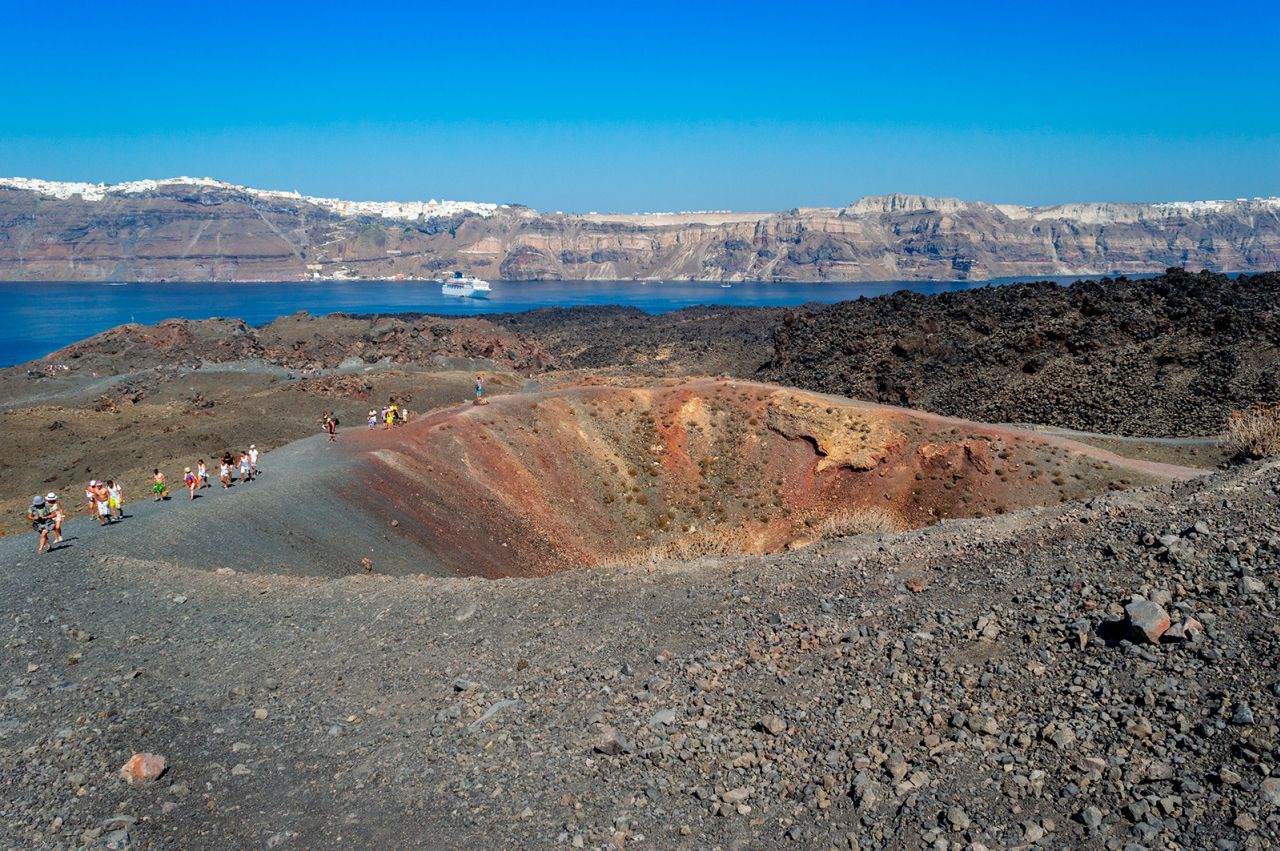
The island visitors walk on did not exist when the Parthenon was built. Nea Kameni surfaced from the water in 1707 and kept growing through the 1950s, which makes it one of the youngest pieces of land in Europe — and the reason the question is santorini volcano dangerous gets typed into search bars several thousand times each summer. The ground is dark, sharp, barely weathered volcanic rock. It looks alarming. It behaves predictably. What a visitor is actually dealing with is a monitored geological park, not an exclusion zone. The Santorini Caldera is a collapsed magma chamber roughly eleven kilometres across, with Nea Kameni and Palea Kameni sitting at its centre as the newest cones. The address is simply Nea Kameni, Santorini Caldera, Cyclades, Greece, and access runs every day of the week, 00:00–23:59, with a 5 EUR entrance fee collected in cash at the landing. A Santorini volcano tour therefore sells transport and guiding, never permission — the island itself is public parkland. Any honest is santorini volcano dangerous guide should say plainly that the risk profile resembles a mid-summer desert walk far more than it resembles a disaster film. That reframing matters because it changes what a visitor prepares for. The lava trail to the crater rim is unshaded end to end, the black scoria stores heat through the afternoon, and there is no water source on the island. Heat is the hazard that sends people back down early, and it peaks precisely when the mid-morning boats unload. The recommended arrival window of 08:00–11:00 exists for that reason: it avoids intense midday heat and peak tour crowds on the exposed lava trails. Sulphur vents near the summit release warm gas with a faint smell, which surprises first-timers but sits well within normal levels for an active Aegean volcanic field. So the practical answer is behavioural rather than geological. Anyone asking is santorini volcano dangerous should convert the concern into three decisions — go early, wear closed shoes with a stiff sole, carry more water than feels necessary. Those choices matter more than the volcano's mood. The other Cyclades landmarks reward casual footwear; this one does not. Visitors who plan around the morning window, budget the 5 EUR in coins, and treat the walk as a short exposed hike tend to describe the crater as one of the calmest hours of their trip.
“The risk on Nea Kameni is measured in litres of water and hours of sun, not in seismic charts.”
Is Santorini Volcano Dangerous? Separating Myths from Real Safety Risks
Misconceptions about the volcanic threat in Santorini frequently spread after minor seismic swarms, causing unnecessary concern for prospective travelers. In reality, the volcanic system is one of the most closely monitored in the world, with local life and visitor excursions operating normally.
MythThe Santorini volcano is about to erupt due to recent earthquakes
FactWhile a seismic swarm occurred in 2025 and early 2026, scientific monitoring confirmed the activity subsided. Greek authorities officially lifted emergency restrictions in April 2026, confirming the volcanic complex is stable.
MythHiking the volcano is currently restricted or unsafe due to activity
FactNea Kameni remains open daily from 00:00 to 23:59 for visitors. Standard access requires only the 5 EUR cash entry fee at the park gate, and trails are fully open under normal safety conditions.
MythEruptions occur without warning, trapping visitors on Nea Kameni
FactThe Hellenic Volcanic Arc Monitoring Committee tracks ground deformation, gas emissions, and seismicity in real time. Any change in volcanic status triggers immediate alert protocols well before physical danger arises.
Past Eruptions: Is Santorini Volcano Dangerous in Historical Terms?
The caldera visitors cross today was carved by the Minoan eruption of roughly 1600 BCE, which expelled some 60 cubic kilometres of magma and collapsed the centre of the island of Thera. Nothing since has approached that scale. The historical record, kept first by Greek and Roman writers and later by Jesuit observers on Thira, is instead a record of small islands being built inside the flooded crater. Strabo documented the emergence of Hiera in 197 BCE. Palea Kameni surfaced in 46-47 CE. The birth of Nea Kameni itself is dated precisely: in 1707, a submarine vent broke the water near the anchorage, and the Jesuit priest Father François Richard's contemporaries recorded pumice rafts drifting past ships. Growth continued through 1866-1870, when the Georgios lava dome rose under the observation of French geologist Ferdinand Fouqué, whose 1879 monograph established the modern study of the volcano. Asking is santorini volcano dangerous in historical terms means examining the twentieth century, when eruptions became frequent but modest. Domes formed in 1925-1928, 1939-1941 and finally in January 1950, the last eruption to date. The 1950 event lasted under three weeks, produced the Liatsikas dome and a short ash column, and killed no one. Every subsequent decade has been quiet. That quiet is the point. The 1707 and 1866 eruptions arrived with only local rumbling as warning; a modern Santorini volcano tour crosses a landscape watched by permanent GPS stations, tiltmeters and gas sensors installed since the 1990s, which is why the question is santorini volcano dangerous now has a documented rather than speculative answer. The 2011-2012 inflation episode was measured months in advance and faded without eruption. What survives on site is legible ground. The dark, unweathered lava flows of Nea Kameni are dated by eye: the 1940-41 tongues, the 1950 dome at the summit, the older 1707 rock beneath. The 5 EUR volcano park entrance fee, paid in cash on arrival, admits visitors to a hillside that is essentially a dated stratigraphy in the open air.
The Minoan eruption ejects roughly 60 cubic kilometres of magma and collapses the centre of Thera, forming the caldera.
Strabo records the emergence of the islet Hiera within the flooded caldera.
Palea Kameni rises above the waterline as a new volcanic island.
Submarine vents break the surface and begin building Nea Kameni, observed and documented from Thira.
The Georgios dome erupts and is studied by French geologist Ferdinand Fouqué, whose 1879 monograph founds modern research on the volcano.
Successive dome-building eruptions enlarge Nea Kameni and join earlier islets into a single landmass.
The most recent eruption forms the Liatsikas dome over under three weeks, with no fatalities.
Permanent monitoring instruments record a caldera inflation episode that subsides without eruption.
Caldera Access: Is Santorini Volcano Dangerous to Reach?
The volcanic island of Nea Kameni sits in the center of the Santorini Caldera, isolated from the main crescent island and reachable exclusively by water. The standard way to access this active volcanic area is by booking a guided caldera boat tour or hiring a private charter that departs from one of the main island harbors.
Tour vessel from Fira Old Port to Nea Kameni jetty
Tour vessel from Athinios Port to Nea Kameni jetty
Excursion vessel from Ammoudi Bay to Nea Kameni jetty
Beating the Heat: Is Santorini Volcano Dangerous at Midday?
The optimal time to explore the Nea Kameni volcano trails is the morning window from 08:00 to 11:00. This early start protects you from the severe heat radiating off the dark volcanic stones and lets you walk before massive cruise ship excursions arrive.
Weekday mornings
Minimal before excursion vessels arrive—
Arriving between 08:00 and 11:00 ensures the lowest ground temperatures on the unshaded black lava path. You will avoid the dense groups that gather after 11:30.
May and October
Moderate tour groups dailyMild 21°C to 24°C, lower humidity
The shoulder season offers cooler paths and easier walking conditions. Ground temperatures remain manageable even if you arrive slightly later in the morning.
June to August
Extremely high daily volumeHot 26°C to 30°C, high sun
Midday heat during peak summer makes the exposed trails physically demanding. A strict 08:00 arrival is essential to complete the loop before the midday sun peaks.
September
High afternoon visitor numbersWarm 25°C to 27°C, dry
Late summer keeps the volcanic rocks hot throughout the afternoon. Plan a morning trip to find cooler air temperatures and calmer trail traffic.
Verdict: Choose weekday mornings from late May or early October, arriving between 08:00 and 11:00 when temperatures range from 20°C to 23°C and crowds are lowest.
Common Mistakes: Is Santorini Volcano Dangerous if You Make These Errors?
Nea Kameni is a bare volcanic cone with loose scoria underfoot, no shade and no shops on the island. Most problems visitors run into come down to footwear, water and staying on the marked path.
Wearing sandals, flip-flops or smooth-soled shoes
The trail is loose volcanic gravel and sharp lava rock that slides underfoot and cuts skin. Wear closed trainers or hiking shoes with a gripping sole.
Bringing no water for the walk
There is no drinking water, café or tap on Nea Kameni. Carry at least one litre per person from Fira or the port before you board.
Leaving the marked trail to explore or take photos
Stay inside the marked path and rope lines at all times. The ground off-trail is unstable crusted rock that can give way, and rescue on the cone is slow.
Arriving without cash for the 5 EUR entrance
The volcano park entrance fee is 5 EUR, paid in cash on arrival. There is no card machine at the gate, so bring coins or small notes.
Skipping sun protection on an exposed cone
There is no shade anywhere on the route. Wear a hat and sunglasses, apply sunscreen before you land, and target the 08:00–11:00 arrival window.
Underestimating how long the walk takes
Allow around two hours on the island for the return walk and time at the crater rim, and pace yourself rather than rushing the ascent.
Safety Guide: Important Precautions Around Sulfur Fumaroles
Understanding gas vent safety and geothermal temperatures ensures a safe exploration of Nea Kameni's active volcanic zone.
Monitor Vent Steam Temperatures
The active gas vents on the Georgios dome release steam at temperatures between 60°C and 97°C. Avoid putting your hands or face directly over the vents to prevent steam burns.
Position Yourself Upwind of Vents
Volcanic gases like sulfur dioxide and carbon dioxide disperse quickly in the breeze, but standing downwind can cause brief eye or throat irritation. Always stand upwind from the steam plumes to maintain clear breathing.
Avoid Low-Lying Gas Pockets
Heavy gases like carbon dioxide can gather in low-lying hollows or craters on still days. Avoid sitting or leaning down in depressed volcanic funnels where oxygen levels might be slightly reduced.
Keep Gear Off Hot Ground
Hydrothermal activity keeps the ground around the active vents warm, with surface temperatures sometimes matching the steam. Do not place cameras, backpacks, or plastic water bottles directly onto steaming patches of earth.
Do Not Touch Sulfur Crystals
The bright yellow deposits around the vents are crystallized sulfur. Touching these formations can cause skin irritation, and transferring the residue to your eyes can cause painful burning.
Step Back If Dizzy
If the smell of sulfur triggers a cough, headache, or dizziness, immediately move away from the active vent area. Air circulation is high on the exposed trails, so taking a few steps back provides immediate relief.
Mobility Realities: Who Might Find the Caldera Trail Hazardous?
Nea Kameni features an entirely raw volcanic landscape with steep, unpaved gravel trails and absolutely no municipal infrastructure. Visitors with limited mobility, respiratory conditions such as severe asthma, or families with strollers should reconsider climbing due to the hazardous, rocky terrain and complete lack of shade or facilities.
The unpaved volcanic paths consist entirely of loose gravel, steep inclines, and jagged lava fragments that are impassable for chairs.
The main trail ascends continuously over highly uneven, dusty, and rocky ground starting immediately from the boat landing pier.
This uninhabited volcanic park possesses no public restrooms, running water, or sanitation facilities of any kind for visitors.
No mechanical transit, elevators, or motorized vehicles are permitted or available to transport guests up the caldera slopes.
Check availability
Safety FAQs: Is the Santorini volcano dangerous?
Everything you need to know about is santorini volcano dangerous